Because life won't slice clean like a radish
Note 2 was about why I brought in the Jiaoshi Yilin. This one is about how its 4,096 poems were actually carried over: the story from the workbench.
A literal translation didn't land
The Chinese classics site I took the source text from also carried an English translation. But it was a literal one, faithful to every character, and from the very first poem I couldn't readily tell what it meant.
So at first I tried rendering the poems in a mock-medieval English, like tarot cards, or as proverbs, adding background notes and commentary to ease the awkwardness of the literal version. Once it was done it looked plausible at a glance, but I wondered how many people would really read prose sprinkled with medieval words. Unsure of my translation, I suppose I wanted to dress the style up and borrow an air of authority.
Polishing it ended up meaning imitating the kindest possible elder, or at least the sayings of an old Native American sage or Master Yoda. Since the vagueness of the literal text had never been the point, the commentary drifted naturally into something more relaxed, like a Dear Abby column. The figures and places from old stories that crowd the book are a wall for an English reader, so I replaced them with images anyone can picture: "one who came before," a mountain, a river.
The funny part was the Korean side. Whenever I tried to do the Korean first, footnotes piled up endlessly out of habit, like the answer key to an exam or a study guide to the classics. So, though English is not my mother tongue, I found myself doing the English first and then carrying it back into Korean. Without meaning to, the Korean ended up neither literal nor commentary, but something in a dressed-up style, like a collection of verses.
A blurred table and a contents page
I turned to a table of good and bad readings out of the same worry. A faithful reading of the source sounds wise once you finish it, and then you wonder what on earth it has to do with you. So, to set the direction of the paraphrase and commentary, I took as a model the summary table in the appendix of an introductory book, the Illustrated Jiaoshi Yilin. For every poem it gives a four-character summary and a mark: auspicious (吉), inauspicious (凶) or even (平). Labelling each poem good or bad was never the priority to begin with.
But once I was handling bundles of data, things changed. It was only then that I learned a bundle of translated files is called JSON, and perhaps because data likes every field to be defined, the AI asked at every turn whether this poem should be filed as good or as bad. It was a bewildering kind of stress.
All a poem's tone needed from the table was a single character per cell, good, bad or even, and since that character sat in bold brackets it usually survived even on a blurred page.
Still, not everything could be read, so I made two images for every hexagram: one of the table, and one of the contents page where the same four-character summaries appear again. Where the table was blurred, I filled in the gap from the summary in the contents. I had quietly wondered whether I would have to type all 128 images out as documents, but with the two pages covering for each other there was no need.
Even if the table says bad
The table was only ever a first reference; the final call would be made after reading the source to the end. The book's four-character summaries sometimes departed from the context of the original.
Such a poem turned up in the very first hexagram. The poem in which Qian turns into Zhun was marked bad in the table, yet the original ends, after a stretch of leaning and losing, with finally meeting the companion one hoped for. The poem in which Kun turns into Sui was summed up in the table as peaceful sleep, yet the room of the long night and the ritual vessels in the original are, at root, images of a funeral. Table and source pointed in opposite directions.
At first I tried to weigh each such poem as it came up. Marks that did not fit the context of the original became something to watch for again and again. Then I changed my mind. Even the judgements and line texts of the Book of Changes are often hard to sort into good and bad, and someone of my shallow depth could not be the one to decide. So whenever the table and the source disagreed, I set the poem to even (平).
But I wanted it to be an even that stays open to good and bad alike, not one that hedges. Not rain or shine, but like sunlight that shines even between the showers. Reality is a matter of fortune turning on itself; it won't slice clean like a radish. The names now shown beside each poem follow the same thought: good is "with the current" (順), bad is softened once into "sun through rain," and even, which holds both, is "both at once" (兩面). That is how a tone that began as a hidden internal flag came to have a name.
Opening up the source
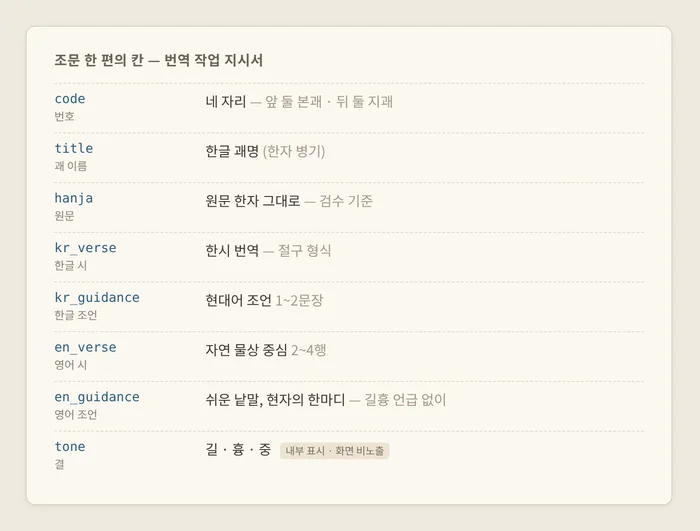
The work was split into sixty-four rounds of one hexagram, sixty-four poems at a time. Hand the AI a poem without its Chinese characters and it would write a plausible new one, so the characters always went in with it, and the first check on every result was that the source field matched what had gone in, character for character.
Tidying the source file brought small discoveries too. All 4,096 poems were there, but the break after each number was a space in some places and a tab in others. On the Ji Ji side one number was missing a digit, and each hexagram's group was ordered not by number but with its own hexagram first. Things that troubled no human reader became, one by one, stumbling blocks for a machine.
What you see each time you open a poem on screen is the original, a Korean poem, an English poem and a few lines of advice. Behind them lie one blurred table, one contents page, and a worry that wouldn't slice clean like a radish.
Why and how this service was made is set out in About daycolor and How it works; the words that appear on screen are in the Glossary.
Open daycolor →