I never thought it would be pearls before swine, quite so literally…
Saju has an old habit of reading its characters as things in nature: 甲 is a great tree, 丙 the sun, 癸 rain and dew, and so on. This is called imagery. The landscapes in this service were the work of painting that imagery for each day pillar, the two characters of the day you were born. But once I set out to paint them, the meaning of the characters and the pictures did not lock together the way I had imagined.
The pig in jewels
Xin metal (辛) is usually read as a gem. So, without much thought, I asked an image-generating AI to paint the Xin-Hai day pillar in a certain month. Out came a pig, plastered with every jewel imaginable. Hai (亥) is the character of the year of the pig, you see. Appalled, I told it to concentrate on the Xin metal, and it stood up a lump of iron shaped like a pig. When I asked it to remove the pig, it tossed a jewel box onto a wooded hillside, as if disposing of stolen goods. With another pair of characters, there sat a jewel box alone in a desert wasteland, like a poster for a crime drama.
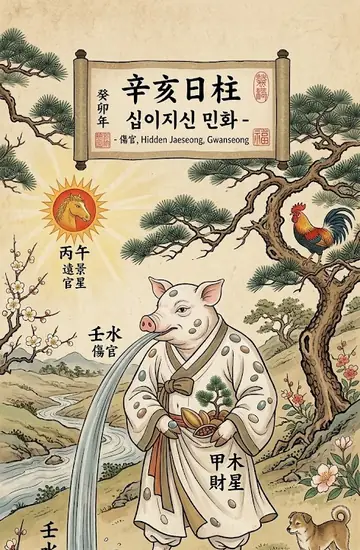
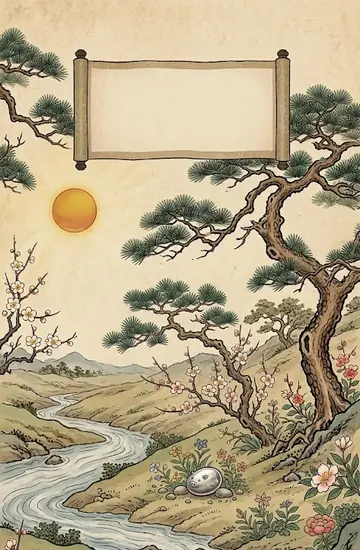
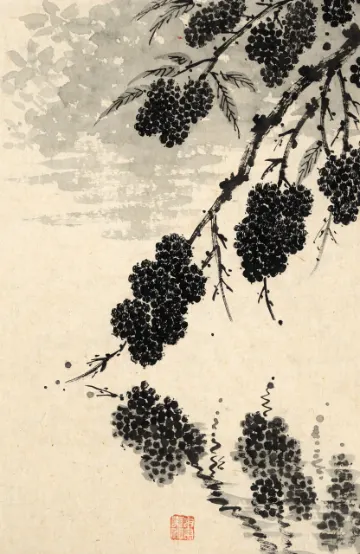
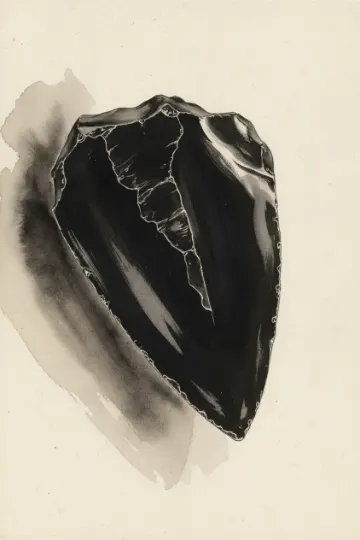
The trouble had begun the moment Xin was called a gem. So in the landscapes Xin became fruit and grain instead: for Xin-Si a red persimmon holding the fire of Bing, for Xin-Hai mulberries on a branch by the water, for Xin-Chou yellow ginkgo leaves. Gems come out only in the woodblock mode, where the same Xin-Hai becomes obsidian and Xin-Chou amber. There was one reason for keeping them apart: so that no one would settle the question one way, thinking "another site said I was a gem, and here it's all fruit."
Animals were let in as little as possible
Just as at a temple you end up picking up a rosary against the three calamities for your zodiac year, talk of "I'm a horse, I'm a dragon" has become common knowledge, like blood types. This service reads not the animal of your birth year but the characters of your birth day. And the twelve animals are received differently from one culture to the next. Is it a mouse or a rat? There are places that see a dragon as a monster and villages that hold it as the emblem of the Son of Heaven, and however much the snake stands for wisdom, it is hard to welcome. Drawn clumsily, they seemed likely to blunt the appeal of the service before anyone even objected.
So the landscapes let in almost no animals. The exceptions can be counted on one hand, and three of them are oxen: for Ji-Chou a yellow ox (diligence and steadiness), for Xin-Chou a white ox (the ox of the ox-herding pictures, sought on the way to awakening), for Gui-Chou a black ox (patience and tenacity, waiting for spring on frozen ground). The three are told apart by the colour of their coats. In truth the black ox of Gui-Chou came from a half-joke I tossed out while puzzling over how to paint Gui water: "Then is a summer Gui-Chou a black ox?!!!" That became the answer as it stood. Besides these there are a white tiger on a rock (Geng-Yin), a whale riding a great swell (Gui-Hai), and an eagle on a rocky peak (Geng-Shen). In the lecture material Geng-Shen is a monkey, but a monkey on a rock does not call up a sense of spirit at a glance, so it became a fierce eagle.
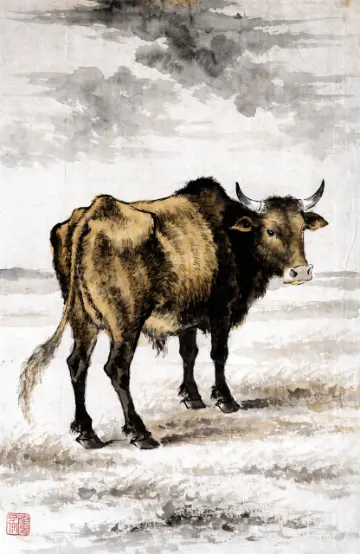
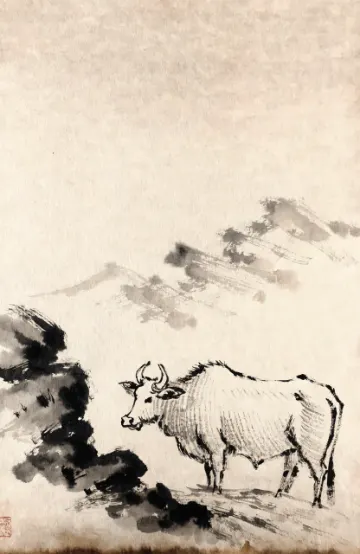
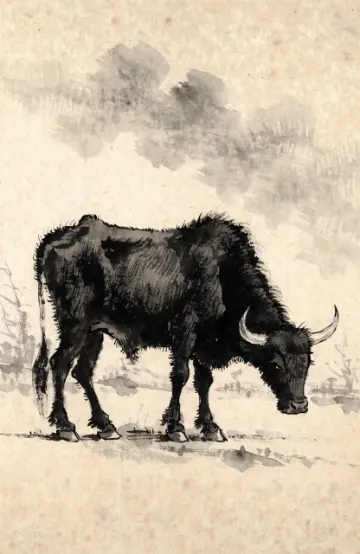
There is a separate place where animals take the lead. In the folk-painting mode the twelve zodiac animals stand dressed in human clothes. Depending on how the day stem relates to the day branch, they wear the dress of a scholar, an official, a merchant, a general or a farmer. In my first notes I wrote, "If there are many peers and rivals, should it be a farmer... I'll have to put a plough on it," and there really is a dog with a tool over its shoulder. There was one condition: personify them, but not like a cartoon. Fussy, yes, but I would like to call it refined.
When the same dam turns up twice
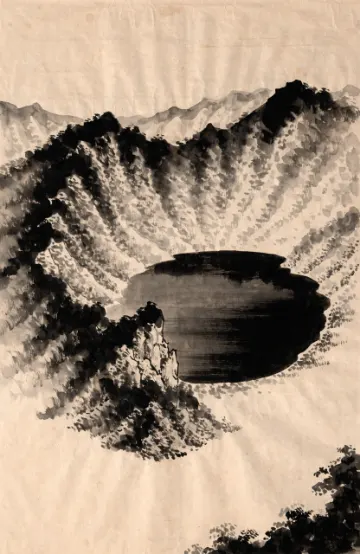
Sorting through the lecture material, I found that Wu-Zi was a dam and Ren-Xu was a dam too. For Wu-Zi, the engineering itself, a structure holding back water like the Hoover Dam, became the subject. For Ren-Xu, when I asked another AI to weed out overlapping pictures, it came back with "a stone storehouse locking away wealth." Plausible as a reading of the chart, but as a picture it was a flat, dull building. So it became water held by a mountain: a caldera lake high on the slopes. Water dammed by people, and water cradled by a mountain.
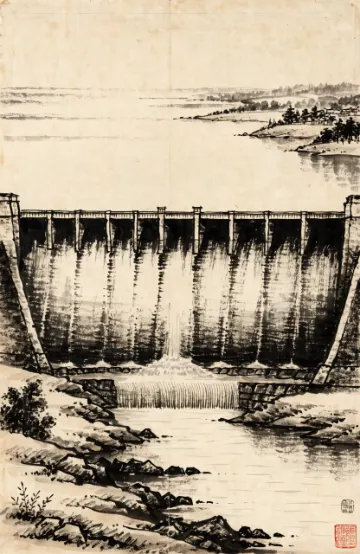
The trees were similar. Every Jia is a great tree, but stand just any tree there and you get a polar bear in the Antarctic or a penguin in the Arctic. So the species were divided by where they live: pine on dry, sunny ground (Jia-Xu, Jia-Shen), fir forming a forest (Jia-Yin), willow by the water (Jia-Zi). Jia-Wu, standing on Wu (午), was painted as a red pine, the pine given a reddish cast. A water-storing baobab was tempting for its meaning, but since it cannot actually live in damp places, I let it go.
Things that look blank from a distance
Gui water (癸) is the water of the sky: rain, dew, mist. Painted as a distant landscape in the manner of Kim Hong-do, however much care goes in, a summer shower or winter snow becomes a blank, straight-faced view. So I stopped insisting on distance and pulled in close, the close-up of modern ink painting. Gui-Wei is a drop of water at the tip of a cactus spine; Gui-You a snow crystal (in summer, a drop splashing up into a crown). For Gui-Si, water drops catching the sunlight were read scientifically and painted as a rainbow.
Shapes that make pairs
I also set one rule of composition for each picture, turning the ten heavenly stems into lines and planes. Jia is a straight vertical line, Yi a soft spiral, Bing rays shooting out in every direction, Ding concentric rings spreading layer on layer like an onion. Wu is a mountain stacked in horizontals, Ji wide concentric rings like growth rings on water, Geng a rough chunk with pieces broken away, Xin a contraction gathering to a single point. Ren is a great flow that wraps around; Gui scattered dots seeping into the gaps. It may be far-fetched, but I had in mind that the pairs which combine (Jia and Ji, Yi and Geng, Bing and Xin, Ding and Ren, Wu and Gui) should interlock in shape as well: line and plane, give and break, spreading and gathering, rising and falling, plane and point.
The flowers I let go
Choosing was also letting go. I had privately been keeping the sunflower, which holds the sun, for Yi-Si, and the peony and the lotus were hard to give up too. In the end Yi-Si got trumpet-creeper flowers in summer and pheasant's-eye in the snow in winter. Only after writing "I am not holding on to it any longer" could I move on to the next stem.
Why and how this service was made is set out in About daycolor and How it works; the words that appear on screen are in the Glossary.
Open daycolor →