It may look like zigzagging, but there is a thread.
The motives behind this service can look like zigzagging. It promises pictures and then an old poem turns up; it says it reads saju and then an I Ching hexagram appears. Still, there is a thread, so I will set it down in order.
It began with an imagery diagram
The original idea came out of a class. Watching a video lecture, I saw the saju imagery diagrams the teacher used as metaphors and examples to help students understand. Could today's AI show these more variously, differently for each person, in several painting styles? That was the question.
The picture I first sketched out was far plainer than what exists now. I wanted to reach even someone who walks absent-mindedly past a tarot parlour with too much on their mind, the way a weather forecast does, or a health check-up report. With a check-up report you first read the front page, "You are normal for the time being," and only when you want to do you turn the pages to see how close to the line the numbers really are. So I thought one plain picture and a one-line, poem-like phrase would be enough: a master's cooking packed into a meal kit, to be tasted at home.
Instead of a black box that goes ta-da and produces a picture once a birthday is entered, I also wanted the pleasure of guessing along: my birthday is built of Lego bricks in these colours, so this is the kind of picture that should come out. You could take the picture as it was, or, if it felt lacking, choose a small picture for the energy you are short of and add it yourself. They say that letting people crack one egg into a meal kit makes them feel they cooked it; I thought choosing for yourself would be the charm.
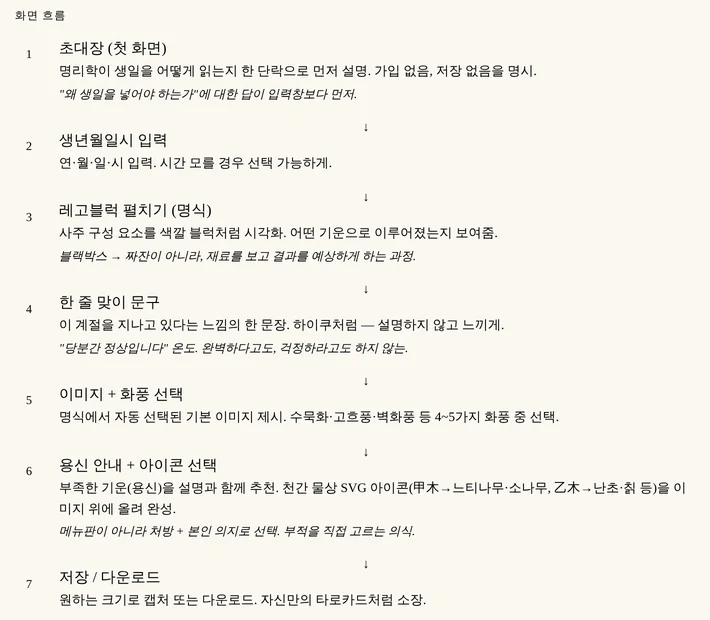
I did the arithmetic too. Ten heavenly stems, times the seasons and the turns between them, times six times of day from dawn to night, came to some 480 base pictures. Add four or five painting styles, ink wash, mural, something like Lee Jung-seob or Van Gogh, and surely each person would feel theirs was different.
The pictures would be prepared in advance
Wanting several modes of expression, I soon had to think realistically about API costs. When I actually built it the waiting was long, and, perhaps because the AI holds too little Korean material, the results swung wildly. I was disappointed and changed the plan. Like tarot cards, the pictures would be prepared beforehand and handed out.
The plan to let people choose a painting style changed too. If there were not enough distinct styles to make the choice meaningful, it seemed better to give each family of cards a style of its own. So now each mode carries one manner: landscape painting, folk painting, woodblock print, blueprint. The landscapes I meant to paint some 480 of became eighty-three.
The sentences would be prepared too
Even after preparing the pictures, I still meant to have an AI write the reading each time. To match the painting styles I paired them with a documentary narration, a first-person novel, an elder's counselling voice, and, leaving the old landscapes behind, a description of the modern and near-future city.
But in drafting instructions for the AI, I found I had no voice to let it hear. It was the stage at which it is easy to mistake the fatigue of making a study plan for having studied. So I took one person's chart and wrote it myself in the four voices. Partway through I wondered whether I was setting up a prompt or writing practice fiction. For the elder I had pictured someone deep and a little witty; he turned into a garrulous, fussing old man. Still, one line survived.
"Even in the dog days, water down a well is cold enough to sting your hands. The ground warms slowly, so in winter that same well water runs warm."
The city, meant as documentary, came out like near-future science fiction.
"In this asphalt-covered place, between buildings lined up like the walls of the Grand Canyon, outdoor life looks hard to sustain even by day. Instead, goods move on the strength of geothermal plants set underground, and green plants tucked into every corner indoors remind you, once again, that this is Earth."
Those four pieces became the voice samples, the way you might let a system hear part of someone's voice and have it make an interview video in that voice.
This time tone and length lurched with the connection and the hour. Pictures could be forgiven some strangeness, since few had tried them; but in a world crowded with clever people, producing polished sentences I would not be embarrassed by, and keeping them all of a piece, looked like a journey full of doubt. So the readings in the four voices were written and refined beforehand as well. The sentences on the screen now are not written anew each time it is opened; they were prepared.
So I brought in an old book
That was when I borrowed the authority of the Jiaoshi Yilin, which I had been reading on the side for fun. There was a hexagram calculator I had built for my own use, and a translation of its verses I had been picking at one line at a time with a machine translator and a search box. An unplanned long march began there. The story of that book is in the previous note.
One month, two months, three months
So it took a month for the calendar engine and the opening screen, two for the pictures, and three for translating the verses. Now it is being assembled and deployed. The translation was far bigger than I expected. Even so, carrying a job the size a publishing house might take on, together with an AI, and watching it go forward, has stayed with me as wonder and enjoyment.
Why and how this service was made is set out in About daycolor and How it works; the words that appear on screen are in the Glossary.
Open daycolor →